Reviewed by Michelle Langstone.

I've loved Murakami for a long time. I have loved him for his fixation on death and sex, and for his strange, disillusioned characters that inhabit his strange, disillusioned worlds. I love the surprising lightness of his touch, and his particular sense of melancholy, coloured with a kind of sweetness that is his alone.

His new book reminds me of his early work, and particularly Norwegian Wood, and I found it engaging and very difficult to put down. I read this book over the course of a day. I couldn't walk away from it. Murakami does not push his magic realism in this novel. There is a quietness in the story, a persistence of memory, and a struggle for understanding that is understated and compelling.

Tsukuru Tazaki narrates this story; a man who has never quite recovered from being rejected by his close group of friends in his late teens without so much as a reason given, he has drifted through his education on the brink of death, lost, confused and alone. When Tsukura meets Sara, a forthright woman whom he begins to care for, he starts to notice the way his adult life has been atrophied by what happened, and he embarks on his own kind of pilgrimage to uncover the truth, and make sense of himself at last.

This novel was resonant for me; the fixation how a moment in our life can change us forever, how it can recur in our thoughts again and again until we can make sense of it; the mythologising of our youth, the seminal moments that mark us. To my mind, Murakami has his fingers on the pulse of lost souls, and when I read him, the strangeness of his characters' outlooks on life feel true, feel raw, feel relatable. Tsukuru is a man at odds with his world because there is a part of him missing, a vague geography that he cannot mark on a map. He is vulnerable and he is young, and Murakami allows him to live simply in the pages.

I wonder how much of Murakami's language is lost in translation, because there is something a little stilted in this book and it made me consider the complexity of translating Japanese into English. Then again, that marked, sparse and yet strangely lyrical aspect to Murakami's writing is familiar to me, so perhaps it was the clean line of the narrative in this case, unencumbered by magical threads, residing in a (mostly) translucent world, that allowed the language a new kind of stillness. At any rate, this is a novel that tugs you in, holds you close, and makes you the kind of promises you made as a teenager, when everything mattered terribly and everything felt too much, and the world seemed to begin and end in the friendships you were sure defined you, and you were certain would be with you for life. 

First edition hardback (with stickers) released 12th August 2014.
$45.
Review by Marcus Schaapveld.

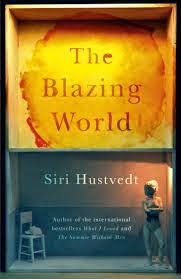
I haven’t recently read a novel with such a complete and well thought-out character as Harriet Burden in Siri Hustvedt’s latest, The Blazing World. As multi-faceted and complex as she is, she is never contradictory and always completely convincing, something not many novels can achieve when it comes to character.

The Blazing World is about Harriet's troubled relationship with the hollow, insincere and deeply sexist art industry in the New York of the novel, Husdvedt having already tackled this subject in What I Loved.  The book is written in a way that can very easily become hackneyed and glib, through a series of posthumous letters and diary entries written by Harriet and her close friends, family, associates and critics compiled by an art historian. As the novel unfolds the portrait completes itself, never with any cheap thrills or twists, only a grimly satisfying confirmation of the world that surrounds Harriet and how it shapes her. Harriet is placed awkwardly into the upper echelons of the art world, marrying a successful art dealer while still young and aspiring. After his death (very early in the proceedings, never fear) shakes her out of comfort and a veneer of well-maintained sanity, she resolves to prove what she has always known about her creative community by exhibiting a series of her work through the successive guises of three male artists. The results are not so much disastrous (at the time) than a cruel reality check for Harriet and those that care about her.

Harriet's surrounding family, friends and lovers are perfectly placed within the story, both within their own voices and without, their presence really communicating the emotional reality that Harriet experiences. The literal and figurative heart of the novel lies here, when we experience Harriet both and her most vulnerable and at her most self assured, her most self-doubting and most triumphant.  The thing about the way The Blazing World unfolds provides us and Harriet's legacy with closure. We catch her posthumous truth on the verge of it's explosion into the wider world, propelled not least by the revelations uncovered by the book itself. such is the fascinating circularity created by the novel. 

All in all, I cannot recommend The Blazing World enough. Go get it!
Our book buyer, Louisa Kazsa reviews this treasure of a memoir.

Narrative non-fiction only seems to get more and more popular, due perhaps to the rise of ‘long reads’ on the internet – perhaps our attention spans are growing, not shrinking? One of this year’s finest examples of the genre has to be Joanna Rakoff’s autobiographical gem, My Salinger Year. Fresh, unpretentious and brutally honest, this is a rare slice of an ‘ordinary’ person’s life that reads as anything but.

Although J.D. Salinger is the star of this book’s title, the book itself is much more an autobiography of Rakoff’s than a biography of the famous author – to the extent that it doesn’t matter whether you’re a Salinger fan  or not. Rakoff wasn’t when, fresh out of college, she fumbled her way into a glorified secretary gig at one of New York’s oldest and most illustrious literary agencies, where the book begins.

With little idea of the implications of her new job, Rakoff is set to work by her formidable, pantsuit-and-turban-wearing, tobacco-smoke-breathing dragon of a boss, who becomes a star of the book in her own right. Rakoff’s first task: dealing with the outrageous volume of fan mail the agency’s most famous client, J.D. Salinger, receives. Having consciously avoided reading Salinger – ‘I had no interest … in precocious children expounding on Zen koans or fainting on sofas, exhausted by the tyranny of the material world’ – she is nonetheless soon drawn into the world of his readers and their deeply felt connections to Salinger’s work. A thankless task soon becomes an obsession, and Rakoff begins to understand the hold the renowned eccentric has over thousands around the world.

Meanwhile, life outside the rarefied air of the agency continues. Rakoff herself can be frustrating – she moves into a unheated hovel with her terrible boyfriend while shrugging off the attentions of those with her best interests at heart, buries her head in the sand regarding her crippling financial situation and isn’t particularly grateful for the unique opportunities her work affords her – but that’s because the book is written so entertainingly, it’s hard to remember it’s not a novel. This is Rakoff’s own life, a tumultuous year in her twenties when she makes her first steps in the real world, with the inevitable unattractive stumbles. That she presents it so unflinchingly makes it a privilege to read.

What the book offers is a truly complex self-portrait, containing multiple narratives. It’s a coming of age story, a literary odyssey and a love story, set in two wildly differing worlds: the cloistered, dusty literary agency, and the drug- and alcohol-fuelled chaos of 1990s Brooklyn. It’s also an homage to New York set against the backdrop of the author’s twenties, in the mode of Patti Smith’s Just Kids (not to mention some of Salinger’s own books).

Rakoff’s life in the city is often bleak, but it has moments of true magic. Exhausted and weak after a hard winter living off ramen in the aforementioned hovel, she takes refuge in the lobby of the Waldorf hotel, only to find a tiny antiquarian bookshop and a sudden memory of the romance of visiting New York as a child, not to mention a vivid impression of what life might be like on the right side of the Brooklyn Bridge. It’s moments like this that render the links to Salinger all the more resonant and make this book a small treasure.
Review by Alex Mitcalfe Wilson

Over the last few weeks I’ve been enjoying The Natural History of Selborne by Gilbert White. White was an Anglican priest, born in 1720 and educated at Oxford university, who worked in Hampshire’s Selborne parish for more than  forty years. First published in 1788, his Natural History distilled four decades of natural observation into a singular and powerful artefact of early botanical writing. It is a book that was hugely influential in its time, anticipating the later discoveries of Charles Darwin by a century and becoming a touchstone for generations of naturalists around the world.


Part of its appeal still lies in the unusual respect it shows for plants and animals; by treating them as as living beings worthy of respect, rather than mere automata or data, The Natural History probably contains more truly revelatory observations of animals’ lives than all the nature writing which preceded it and much that followed. White’s gaze lingers in awe on everything from pond beetles to eagles and his fascination with living things shines through his every word. Selborne is White’s love letter to his local landscape and its inhabitants; a text that balances rigorous scientific observation with sparkling curiosity, humour and joy.


Another aspect of the book’s appeal is its effortless weaving-together of the natural and human spheres; few of White’s descriptions of creatures and views don’t also touch on the centuries of human history that have settled down about them. White’s writing crackles with wry historical anecdotes and a keen ear for the environmental rhythms of country life, describing the vanished rituals of the English harvest and hunt in ways that demonstrate how the boundaries and possibilities of human life have always intrinsically ecological. Selborne reminds us how the plants and animals of a place are always in conversation with its people, whether the people recognise it or not.


The Natural History is an inspirational survey of the unheralded lives and beauties that crowd at the edge of our notice. It is a book that shows us the richness and importance of ordinary places and reminds us how an exploration of the living world will always make us more aware of who we truly are. Selborne reminded me of the many charged instants when I have seen the plants around me in a new light, of the flashes in which I remembered names and recognised order in what had only been a green puzzle before.

The Go-Between (1953) by L. P. Hartley
“The past is a foreign country; they do things differently there.” 
Leo Colston is rifling through old papers when he stumbles across a journal he kept as a schoolboy, in the year 1900. The pages of mundane information are enough to remind him of the summer he spent with his school friend Marcus at the Maudsley Country Estate.
A young Leo gets swept away in a world where he meets Lords and has his crumpled clothes are picked up by servants. His naivety is pounced upon by Maudsley daughter and a local farmer as they embark on a forbidden love affair. This is a richly layered story about past and present, knowledge, and the mysteries of the human heart. 
This book was recently discussed by Kate Camp and Kim Hill on National's Saturday programme and it’s worth looking up the podcast. With touches of The Secret History and Stoner - this one of the best books I've read this year.

In the late nineties, Joanna Rakoff moves to New York City to take a job as the assistant to the literary agent for J. D. Salinger. She spends her days in a wooden office full Dictaphones and typewriters and old-time agents and in the evening she goes home to her threadbare Brooklyn apartment.
Given the great task of answering Salinger’s mountainous pile fan mail, Rakoff is moved by the touching and heart wrenching letters from his readers. She chooses to abandon the decade old standard template response and starts replying. Over the course of the year, she finds her own voice by acting as Salinger’s, on her own dangerous and liberating terms.
Set in the nineties, but in a feeling of the sixties, My Salinger Year is a great tribute to one of the world’s most beloved, yet private writers.

After the success of The Watchtower (1966), Australian author Elizabeth Harrower withdrew her last book, In Certain Circles before publication in 1971.
Zoe Howard is seventeen when her brother Russell, introduces her to his comrade from the war, Stephen and his sister Anna. Having had lived a privileged and sheltered life, Zoe is completely mystified when meeting these orphaned siblings, “You only think of orphans in fairy tales…wandering in, hand in hand out of the woods all misty and neglected and bedraggled.”
Zoe and Russell, Stephen and Anna: they may come from different social words but all four will spend their lives moving in and out of each other’s shadow.
In a similar vein to Stoner and Mrs. Bridge, this long lost novel is a welcome and relevant addition to our Time Out favourites. In Certain Circles holds its own today as an intense family drama about family and love, tyranny and freedom.

This is the true story of Nathan Penlington, a poet, performer and writer. He is also a self confessed obsessive and when the opportunity to purchase one of his obsessions - a set of the first 106 volumes of Choose Your Own Adventure – on ebay, he bought them immediately. Upon receiving the series, he notices each one is marked with the signature of the original owner, Terence John Prendergast.
Settling in to relive his childhood nostalgia, Terrence’s scrawled handwriting follows Nathan as he reads – jokes, annotations and notes are scribbled in the margins. Then, a heartbreaking message is found amongst some loose bits of paper.
Left school with intention to kill myself
Nathan needs to find the truth about Terence’s entries. This child, growing up in the 1980s, who was lonely, unhappy, with no self esteem. Is he twenty years too late? Who is the boy in the book? Is he even still alive?
On this very stormy Wednesday, Taylor Adair gives some advice on the best books to read in the bath.

In my opinion there is no better way to easily relax than to have a long, hot, bubbly bath. My family have always been bath people. After a recent long and tiring day at work my Dad came home and just had the look about it, my first words upon seeing him were: "Can I run you a bath Dad?" The cure to a bad day, the cure for a tired body, the remedy to the blues of a cold winter's night, a bath has healing properties beyond the physical. To ease your spirit and rally your mind.

Now you're all asking, 'Taylor I came to this blog expecting to read about books and all you've given me is a paragraph about why baths perhaps the best things in the world?' Well, wonderful reader, there is something that can maximize the healing and relaxing powers of a bath, and that is what I like to call a 'Bathable Book.' In reality any book can be a Bathable Book, but I thought I'd share with you a list of some books that I have found are exceptionally good Bathable Books.

What I deem an exception Bathable Book is a book that; gets me running more hot water at least twice, because I've been in the bath reading for so long; makes me want to run a bath just for the sake of reading my book; draws you completely into it's world; is NOT depressing; is of a good size (not too big or thick as this makes for a more perilous bath/reading experience)

These books range from newish releases to books that came out a few years ago, there is a mix of adult and young adult fiction, but what they all have in common is their exceptional Bathability:

One of my favourite series, a page turner with great characters and witty, clever writing.

The modernisation of the Jane Austen novel. Though I did find this book a little cringe worthy in parts, it was a fun, light read if you take it with a grain of salt.

The beautiful and heart-breaking story of Hemmingway's first wife, Hadley, that has been poetically written.

The servants of Pride and Prejudice have the chance to tell their story in this book that brings you so far into their world your hands will feel red from the laundry.

What if the Queen of England discovered an unquenchable love for books and shirked her responsibilities in favour of curling up with a book? A fabulous short novel from Alan Bennet about just that.

Society has been reduced to probability and algorithms, everything is decided for you based on an equation including who you will spend your life with. A great page turner of a series of what our world could become.

Magic, mystery, and a strange circus. This book went straight to my top five, the perfect escapism that is still incredibly well written.

A bad analogy of this book would be to call it a cross between Lord of the Rings and Harry Potter, but it is a great fantasy story full of magic and journeys and mystery.
Wyo Paul

It is sometimes difficult to recommend, or find, truly engaging and original science fiction novels that could appeal to a wide adult audience. Fantasy is more accessible and perhaps a more popular genre, often dominating the ‘otherworldly’ section of book shops. As wonderful as fantasy is, and as much as I love these books that can range from beautifully surreal and magical (The Night Circus) to dark and twisted (Let the Right One In), there is something particularly poignant and sharp about the plausibility of science fiction tales.
Science fiction is sometimes stereotyped as geeky, as stories about spaceships, aliens and impossible technology. However, this is not how I see science fiction: unlike fantasy, which brings to life mythical creatures, superhuman beings and magic, science fiction novels tell the stories of worlds which could, plausibly, come about and develop from life as we know it. Discussed here are two very different science fiction novels that you don’t need to be a sci-fi lover to love.
This is a hugely engaging, exciting and entertaining novel, often funny and sweet, which I stayed awake all night to finish reading. Set in 2044 on Earth, ‘Ready Player One’ manages to show a very pessimistic possible future, characterised by extreme overcrowding, environmental catastrophe and poverty, while not focusing on these features, lecturing the reader, or creating a dark or negative atmosphere. To escape the harshness and depravation of reality, most humans in ‘Ready Player One’, including narrator Wade, carry out their lives in a virtual utopia called OASIS. The creator of OASIS has died, leaving the control of his empire and fortune to the winner of a momentous quest within the virtual reality. Wade battles against millions of others in this quest of riddles and 80s pop culture, in a hugely engaging and exciting journey. This novel would appeal to both science fiction fans (and especially those with 80s culture knowledge) and anyone after a novel that is fun and keeps you reading until 5 am.
This novel is one of my absolute favourites. Written as the records and diary of John Farrell, this novel spans about a century, starting with the discovery of a cure for aging. While this is not a new idea, the realness, complexity and imagination that this book brings to the idea of immortality is hugely refreshing. The story begins with the Cure, and the various arguments for and against its legalisation, and then unfurls with the consequences of having an immortal population in a world of limited resources and space. As can be imagined, the consequences are not pleasant. Unlike so many books that are largely focused on the main characters, I loved this novel for its clever and thoughtful exploration of the different political, social and economic results of the Cure around the world. Magary has clearly put a lot of thought into this novel and creating an immortal world that feels sadly very realistic; this book looks into how immortality would affect marriage and divorce, government policy, internal conflict, families, prostitution, freedom, crime and justice. Absolutely, this novel is dystopian – if you want a light, fun read, this is not for you. But if you are after a story that is thought-provoking, intelligent, dark, critical of people, science and politics – I have not yet found anything better.