Showing posts with label Interviews. Show all posts
All Tomorrow's Poets 2016: Samuel Te Kani

In our final interview before National Poetry Day, Cait meets Samuel Te Kani to talk about call-out culture and being a creative in Auckland.
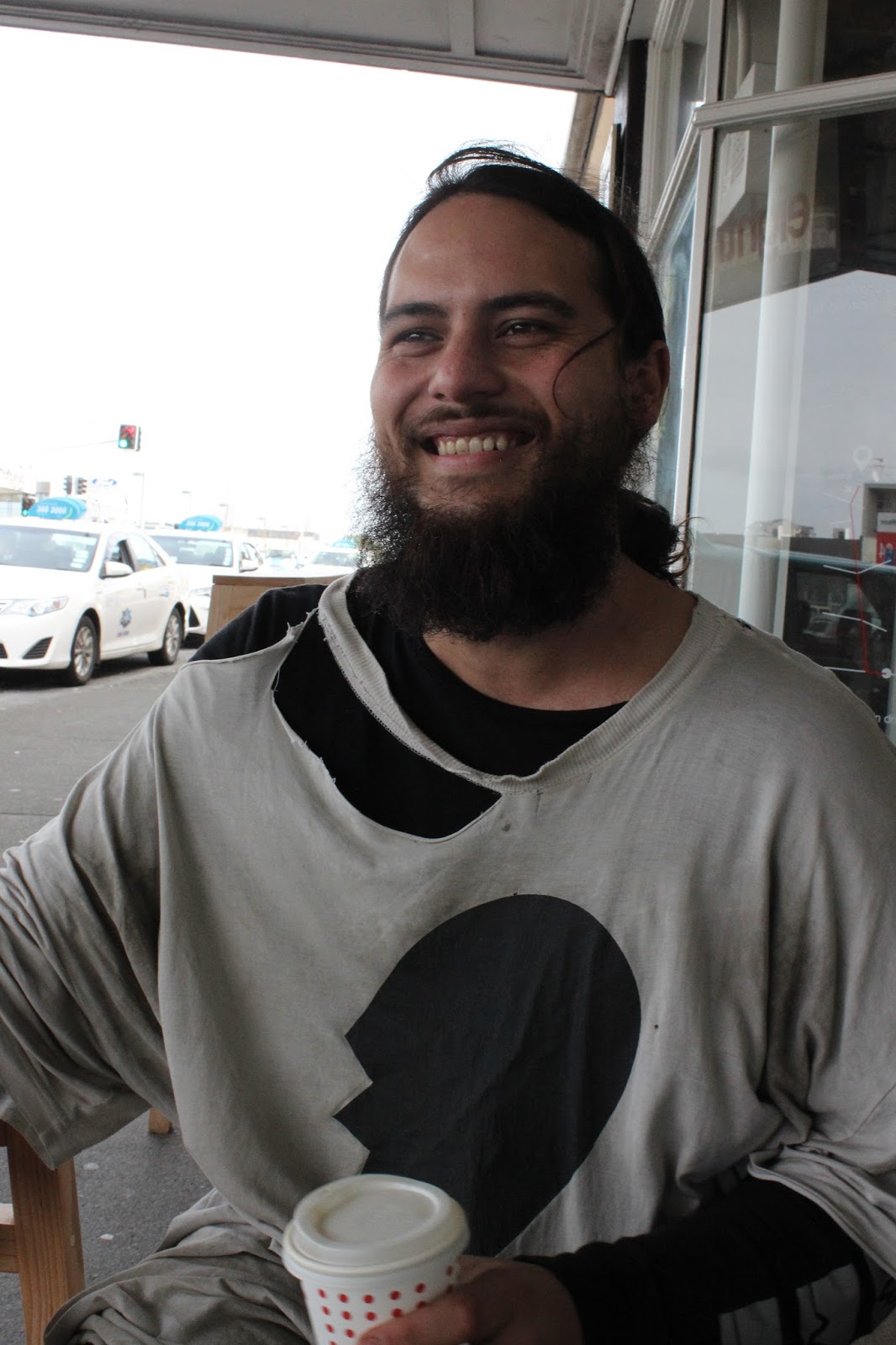


Cait: Sam! How did your writing practice begin?


Sam: I had this romantic idea about myself when I was a teenager that I’d be a writer, so I had that incentive. I was motivated more by the title than by any kind of practice, to begin with. I guess that might be a millennial thing, I don’t know… But it came from idolising writers myself.


C: Anyone in particular?


S: Oh, Iris Murdoch and [Haruki] Murakami. Because they were next to each other at the library. [laughs] That’s how I discovered them simultaneously. I fell in love with the relationship between a writer and a reader who had just found their writing really haphazardly–– that that contingency could be so fucking profound.
Oh, also, I’ve been really interested in the occult since I was about fourteen. Textual interests: THE OCCULT.


C: You mentioned in a past reading that you have used reading/writing to contextualise feelings of alienation.


S: Yes! Acquiring writing as a weapon, which I don’t think I necessarily do consciously–– though, there are a bunch of people in Auckland that I’ve fallen in with who are, by osmosis, teaching me how to do that weaponised writing. Because I fell in love with prose first. I’ve had to really laboriously access poetry–– I was all about sci-fi and secondhand modernist lit first, because that was accessible. Now I have a bunch of activist friends and a bunch who are sociology majors and it’s nice to have their writing as examples of some use other than escapism. Even if my first loves were all escapists.


C: It sounds like they form an important writing community around you.
S: Yeah! That’s what I went to university for. I wanted to write, and I wanted a community of like-minded individuals––which is actually something I’ve become less enamoured with. Yes, like-minded people are great, but I’m such a sucker for confirmation biases. Anyway, I thought university was going to provide that but I became so disillusioned there. Now I’ve found it here, just from living and working on K Road. For a very long time, K Road’s been a Bohemian Mecca or whatever. I know I should feel awkward or embarrassed to say that but definitely, it is.


C: Owen [Connors] mentioned that you would hate to be referred to as a poet.


S: No, don’t call me a poet. [laughs] Not that I have an aversion but… that would definitely feel uncomfortable for me. [Reading at National Poetry Day] is cool, I like doing things that make me feel uncomfortable. Writing poetry definitely makes me feel uncomfortable, it’s not something that I’m confident with. But that’s great, that’s how you give yourself range.


C: What are you working on at the moment?


S: I’m doing some work for Vice, which is great. They’ve given me creative freedom. I made a video work for them and now they’ve asked me to go and see Poi E. I gave them a piece about call-out culture where I was calling it proto-fascist [laughs] and I hope they run it because it seems so relevant right now. We’ve got this virtual space that’s meant to supplement social reality and which should by definition be democratic, and it’s become this non-safe zone. It’s a minefield, you know. You never know what’s going to trigger someone, and I’m not saying we should blunder through being indifferent to difference. But we need to find a language that’s not as violent to maneuver around difference–– not just name an enemy and blast them to Hades.
It’s important that people are being engaged, not pushed out like a splinter. A language of call-out also isn’t delicate enough to properly maneuver the intersection of race and class. You just can’t lump them together. Good times though [laughs]. What is the logic of that language?  
It’s inherently violent and I wonder what people are trying to pull off. Are they trying to destroy people, or are they trying to enact some kind of pedagogy?


C: Owen and Greg [Kan] have both mentioned a commitment to locating their creative practices in New Zealand. Is that something that is important to you?


S: What is the main complaint of anyone who is dreaming of going to London or New York? They’re going because they don’t think anything is happening here. But why is that? Because each successive generation falls into that trap of dreaming on a global scale. Which is a really hegemonic sentiment. It’s a very capitalist notion too, that you can’t enact anything if you’re not in those cities of control. We’re the youngest country in the fucking developed world. We’re a country that’s still in it’s adolescence, and is still vital. If you dream [of going overseas] it’s because you’ve chosen that narrative. It takes a lack of nerve and a lack of vision to say there’s nothing in Auckland. There are a lot of people living in Auckland, babe. [laughs] It’s a pretty big place.


Sam will be reading for us at All Tomorrow’s Poets on the 26th of August at 6pm.
Read Sam’s work for VICE here

All Tomorrow's Poets 2016: Makanaka Tuwe
Suri and Cait meet the inimitable Maka in our next National Poetry Day interview.


Suri: Is there any poetry that you grew up with that still resonates with you now?


Maka: It wasn't until I started doing English literature in highschool that I read my favourite poem, I Know Why the Caged Bird Sings. I was in Year 11 and had just come out of my rebellious stage of my life, which was brought on by this on-going trauma of displacement. That was the first poem that really resonated with me. In school they teach you that poetry  should rhyme and have some sort of flow to it, but the poetry that I like tends to be a really raw play on words; really sharp and to the point, almost quite radical- the stuff people are uncomfortable talking about. That's the type of poetry that struck out to me.


Suri: I find it really interesting, the way that poetry is taught in school and the way that we consume it- there's just such a big difference. When you're writing yourself, are you quite conscious of the formal rules you were taught and trying to unteach yourself those rules?


Maka: I've always been a bit of a rebel. From a very young age I was questioning everything and doing things the way they weren't meant to be done. When it comes to writing, it doesn't feel like a conscious effort- I just write down whatever's on my mind. When I first began writing, I always wanted to make the first draft perfect. The older and more self-aware I've become, I've realized that I can just sit there with a pen and a piece of paper and I can shut my brain out and write whatever is in my heart, soul, and spirit in that moment. I've had moments where I've been doing laundry and thought 'Oh my god' and just grabbed a massive notebook. I feel like art and poetry come from the soul, so when people write, there should be a conscious effort not to write to a particular standard or style, because it's an extention of who you are. Otherwise, if you write to a particular style or standard, it almost feels inauthentic.


Suri: I think also, those quite conventional standards for poetry are archaic, in that they don't keep up with the way that not only language is constantly changing, but that the entry-points to poetry are also changing. I think it's really great hearing the creative process of someone who's navigating new waters in poetry. Are there any other new poets that you admire?


Maka: Jarah. Jarah, Jarah, Jarah.  She's a very good friend of mine. She's one of my favourite poets in the world, because she doesn't a flying fuck, and I think that's really important in the creative community. There's this element of the elite in the creative community, and there's almost a certain way of doing things and presenting yourself. [Jarah] just flicks the middle finger to all of that and speaks her poetry. She talks about indoctrination and colonization of people of colour, the brutality that continues to happen to happen to indigenous bodies. She invited a bunch of us to come up on stage with her and each of us brought our ancestors there. and she was took us through the process of being a woman of colour, not of this place, and the experiences we go through. It doesn't look beautiful but it's very powerful. I also love Bell Hooks, Alice Walker, the late Maya Angelou, Taiye Selasi. I really like poets and authors who speak about things that are uncomfortable

Suri: It was really interesting hearing you talk much earlier about finding new ways of presenting your work and not liking formal presentation styles. I feel like a lot of the terrible and uninformed ways that people talk about spoken word are caught up in these racialized and class-stratified ways of understanding 'formal' or 'worthy' poetry.


Maka: I host spoken word nights at Neck of the Woods once a month. I've asked them to stop calling it spoken word; it's freedom of expression. Once you say spoken word, people feel like they have to put on a voice. Honestly, if you have shit to say and you grab your phone and speak to me the way you're speaking to me now, that's still your voice. You don't have to change anything. There is this real pressure for people to perform their work in a particular way in order for them to fit into a particular genre, and it shouldn't be like that.

Cait: I've been asking the other poets to ask questions of each other- Owen wanted to know about people in your immediate community that you look up to.


Maka: I always find it really interesting when people ask who their heroes are, and people always answer with names that are so far removed from them- which is fine. I always look around me because I feel like the women that I surround myself with are doing amazing things.  Each and every single individual that I'm blessed to know is doing something great for themselves.

Suri: Being a creative person who's been publically interviewed, do you feel like sometimes you're asked questions that are tailored in specific ways; questions that they might not ask of creatives who don't identify as women of colour?


Maka: Oh, hell yeah. I always want to know what the questions are, just so I can be like "Oh, by the way, number five? Not happening. Number 10, you can forget about it. And number 3, I can't figure out where you had me fucked up asking me a question like this?" Some of it feels like a micro-agression, you know? Things like questioning the relationship between me and my father. I get it, I know the media doesn't portray black families or families of colour in a great light, but that's not my reality. I love New Zealand, but sometimes they tailor the questions to make it seem like New Zealand saved my life.


Suri: What doors did K Road open up to you?


Maka: I hosted my first fashion show-case on K Road at Tikaranga Trust. It was really weird, I was on K Road one day, and I was trying to go somewhere else and I ended up walking up the stairs to K FM, and I walked in and I was like 'Duh?' It was so funny, I was meant to go to the building across the road but I got my GPS messed up and I ended up upstairs at K FM. A few of my friends are creatives on K Road, and places like Neck of the Woods have been great for spoken word nights.


Suri: If anything, K Road tries to foster support and a community for creatives in a way that many places in Auckland don't.


Maka: Exactly. I love K Road because everyone's just doing them, and I really appreciate that. I really appreciate that everyone is so opening and so welcoming of each other. You could be sitting outside Verona with your friends, and there'll be randoms there, and the next thing you know, you're talking and looking each other up on Facebook, and then someone's coming over to your house for dinner. That's the vibe that I like, because I've always come from a collectivist background.


Suri: Tell us more about your spoken word nights at Neck of the Woods.


Maka: I've titled them Freedom of Expression, and there's a different one each month. So I was sitting at home one day, and one of the girls got in touch with me and asked if I wanted to host spoken word nights at Neck of the Woods. I was like 'Cool, perfect. I don't know what I'm doing, but let's do it'. The first theme was womanhood, and it was about dissecting the experiences of women. I always say to people at the very beginning, 'This is a space for you to be you. This is a safe space. Feel free to feel whatever you want. You can come on stage, and you can scream if you want. Just don't scream too loud, because I like my ears'. The second theme was about problematic hyper-masculinity. I started out talking about my dad and my brother, the first men that I'd ever come in contact with. We had guys coming up on stage talking about their suicide attempts because they don't feel like they're man enough. It was beautiful. The third theme was about people's perceptions of Africa. Next week's theme is about questionable intimacy. People always think that intimacy is about two people, but whatever impacts your being or your essence, that's intimate to you. Initially, I was going to open it up with how I met my current boyfriend, but now I'm going to open it up by reading out all the names of the people who have been brutalised in America, because as a woman of colour, that impacts me. They're all open mic, and I usually ask two or three of my friends to share some pieces, and I usually have five reserves aside, and sometimes I pick out a few people from the audience.


Suri: Do you think creating a safe-space for poets cultivates better work?


Maka: I think it does. As I was saying to you before, art is for the soul and the soul needs to be nurtured. I do my best to do everything based on a love ethic, so because of that, I believe safe-spaces are so important. I feel sometimes that when you're a creative, you become a little bit more hyper-sensitive to a lot of things, so even sharing your work can be something that's harrowing and traumatic. Safe spaces allow you to be more comfortable in yourself and more comfortable in your magic, which enables creative work that is an extension of how magical you are as a being.

Makanaka will be reading for us at All Tomorrow’s Poets on the 26th of August at 6pm.

All Tomorrow's Poets 2016: Bianca Rocca


Cait meets third year Elam student Bianca Rocca to discuss writing as part of a contemporary art practice.


Cait: You’re going to be showing a video work on Friday night. Can you tell us what Contact/Looking from a distance is about?

Bianca: I made this video for a project at Elam in second year. It was a self directed brief and I wanted to think about how people deal with memory and archiving online. I started by pulling a bunch of weird, obsessive videos from Youtube-- people walking home, washing fruit, filming their family at the beach.  I was thinking about the preservation of relationships that happens online. During that time I was writing about a few difficult relationships I was having, and how I was dealing with their beginnings and endings through onlineness. The video has both of the people that I wrote the final poem about, and me, reading it aloud. It’s cut and chopped and played alongside the found videos.


C: How does writing feature in your artistic practice?

B: At the start of each project I go back through my diaries, and that’s sort of where I pull responses to briefs from. In terms of writing being incorporated into the final work--- Contact was the first time I’ve done that. I write for myself, to process things. If that writing relates to a particular project then that’s great. But I don’t really begin a project and decide I’m going to respond to it with writing.


C: You’re currently writing a script! What kind of project is it for?

B:My work after Contact was also text oriented. I made lots of posters-- it was about feminism. This script that I’m writing is a continuation of that project. I think that in art, text based practice is very powerful but not really…


C: It’s kind of hierarchised.

B: Yeah... You have this separation between art theory and art. I think that disjuncture is illogical because text can be just as abstract as visual arts can be. Often that’s a really direct way of communicating. I decided that for this project, the ideas that I’m dealing with-- which concern problems with white neo-liberal feminism, needed to be dealt with directly because of the audience I’m trying to talk with. This script is hopefully a direct way of doing that. I want to make an essay film using found footage from online, much like Contact.


C:Do you have any influences that you constantly return to?

B: Chris Marker is a major. His film Sans Soleil was a massive influence when I made the video I’ll be showing on Friday. I always reread that monologue and think about how that text functions-- drawing quite obscure connections between concepts.


C:Your writing is often about very specific people-- in this case to the point of actually including the voices of the poem’s subjects. What draws you to this autobiographical kind of writing?


B: With this project, the poem was written only about a week before the deadline. I didn’t have time to fictionalise what was happening. It felt more relevant to the videos I was working with to have the text directly attached to me. I suck at fiction, and I don’t think I can realistically make up characters and events-- it disrupts what I’m trying to say if I attempt to skirt around portraying people that I know. But there are issues around writing about real people because usually I’m writing about my feelings being hurt [laughs]. Often if the people I’m writing about read my work they can feel quite offended or concerned. Contact had some tricky implications for me and the other readers. [laughs] But that’s all learning.


Bianca will be showing her work at All Tomorrow’s Poets on the 26th of August at 6pm.

You can follow her work on Instagram here
Photo by Matt Hunter
All Tomorrow's Poets 2016: Zarah Butcher-McGunnigle

Next in our poet interview series, Cait meets her absolute favourite: Zarah Butcher-McGunnigle. The pair discuss starting out, performance art and Autobiography of a Marguerite.


C: How did you find yourself writing poetry, Zarah?
Z: When I was little I was always writing–– I think I probably started out with stories, kind of mimicking stories I found and then passing them off as my own [laughs]. I feel like I probably got into poetry around age 8 or 9, and properly into it around 13 or 14… I always wanted to put a book together. I had a document on my computer called ‘Poems for my poetry book,’ of which I think the working title at the time was Thoughts in a Box. Oh god. From about that age I had this poetry book as a goal, and I would send my work off to writing competitions for high schoolers. When I was about seventeen I sent some poems to Turbine. I got one published and I think that was the first time I was involved in this adult literary world.


C: Tell me about the process of writing Autobiography of a Marguerite.
Z: I think the year before I started writing it I was thinking a lot about autobiography, and I was doing a course at Auckland Uni about Writing Selves. We had to do writing exercises as part of the course which made me start thinking about memory and trauma. I was reading Georges Perec, W or The Memory of Childhood, which has two narratives going on at the same time. One is quite a normal autobiography with plain language and the other is a fictional story. As it goes on you realise it’s kind of allegorical and the worlds start to get closer and closer. You realise the trauma there, and it mirrors the way that memory or trauma can work–– coming back, interrupting the present. I think my interest in autobiography started around 2010 when Greg [Kan] showed me a book called My Life by Lyn Hejinian. It was one of the first times I was introduced to experimental language writing. That, and the teachers I had at the time, changed things for me. It really started me off on a different track. I felt interested in writing something that has autobiographical elements, but also in interrogating the genre itself––  trying to understand more about identity, and how the past and present influence each other.


But also importantly: part of the process of writing the book was probably working on another manuscript [currently unpublished] the year before, and the reading done around that. The manuscript was a collection of experimental prose poems, dealing with themes of illness and life patterns and beliefs and identity. I was influenced a lot by [Eric Berne’s] transactional analysis, a book called “Love Your Disease: It’s Keeping You Healthy” by John Harrison, and a book called “You Can Heal Your Life” by Louise Hay.  Harrison’s book was pretty important to Autobiography of a Marguerite. It inspired me a lot when I was writing the first section of the book. Also, I didn’t want to write a journey of a specific illness with medical details but I wanted to explore illness in relation to family and identity, and how they all interact..How does a person deal with their illness? How do other people react, and how does the reaction of others alter the way someone deals with their illness? Does illness become part of a performance? Is illness (socially) rewarded or punished? What value do we give illness x or y? How does it affect relationship dynamics?

C: There’s a parallel there with Greg’s work in This Paper Boat. Do you influence one another?
Z: We were in the same MA class, and we became interested in quite similar things, both in content and form, as the year went on. Greg and I have been ‘poetry buddies’ since about 2010. We’d talk about this stuff a lot and show each other our work.

C: Do you have any other influences you constantly return to?
Z: There are a lot of books that I re-read. Allison Carter, and Amina Cain, and Leslie Scalapino are very important to me. Also R.D Laing. I feel like this year I’ve mainly been re-reading things and haven’t been able to finish anything new. Last year when I was feeling blocked, I started looking for things outside of the writing sphere. I took a printmaking class. And I became really interested in performance art and conceptual art, and I spent a lot of time on the internet looking at video/performance art online. Molly Soda, Hana Pera Aoake, Marina Abramovic, Sophie Calle. I think music, as well, has been quite a big influence over the last year or so. Actually, a giant influence. Also Twitter and Instagram. I think they’ve been a greater influence lately than any particular writing.


C: How do those performance artists influence your writing practice?
Z: I feel like I’ve been interested in intimacy, and artifice, and sincerity, and that these artists encourage my thinking around those things. I started recording conversations with people I was seeing in a romantic/sexual context. I’d put the dictaphone on with the hope we’d forget it was there. I wanted to capture intimate conversations, partly because maybe I could use them in some way later, for writing or another project.  Performances can feel very intimate and sincere, but they are also very artificial. But the artist makes a space, and they are bold in doing so. I like the assured energy. I want my writing to feel quietly assured. Watching a performance can feel very intimate..especially when you are alone...I suppose I want to create a similar kind of intimate atmosphere with a poem.


Zarah will be reading for us at All Tomorrow’s Poets on the 26th of August at 6pm.
Autobiography of a Marguerite is available here
All Tomorrow's Poets 2016: Dominic Hoey aka Tourettes

Dominic Hoey (AKA Tourettes) is an Auckland-based poet and rapper. Suri caught up with him to talk sex, politics, rap, and the burgeoning Auckland poetry scene. 

Suri: What is it like to be a poet in New Zealand?

Dominic: I think it’s changed a lot. For a long time it was something that I just did, like a lot of teenagers, and then when I was about 20, I started performing at the Poetry Live scene. It’s always been a marginalised discipline but recently, with the explosion of spoken word, there’s so many different practitioners and collectives. I’ve definitely noticed that if you have an academic pedigree, there’s doors that open to you, which are maybe a bit harder to get through otherwise- especially if you’re criticising power structures, which I always end up doing.

Suri: When I read your work it didn’t feel like you had to censor yourself, but do you have that at the back of your mind sometimes? Is it difficult to straddle the line between being honest and protecting yourself?
Dominic: What I’m very aware of is talking about sex as a hetero man. I would probably talk about it a lot more if I wasn’t. My friend is queer and he has a lot of poems about sex, degrading sex, and it’s amazing, but for me to do that... My friend thinks I’m a coward, and that I should do it anyway. I was reading Hera Lindsay Bird’s poem [Suri: Ah, she’s so good!], yeah she’s amazing, but I was thinking “Fuck, there’s a lot of poems about sex that I haven’t put out." My partner’s also pretty prominent in her community and I don’t want to jeopardise her or her work. Those are the only times, and it’s really to my detriment sometimes. I’ve really burned a lot of bridges.

Suri: You reckon?
Dominic: Fuck yeah, I’ve never gotten funding. But I think it’s really important to criticise, or at least be analytical of the narratives around New Zealand. I have a poem about Richie McCaw and on the one hand, I’m making fun of that rugby culture, but on the other hand I’m saying “Why is this the narrative? This isn’t my life”. We shot a video for it recently, and there were a dozen people there passing around a rugby ball, and my friend was telling me that he'd never held a rugby ball before. I don’t think anyone in that room had, but if you look at everyone in that room, they were all quite prominent in their various disciplines- and yet they don’t fit into that narrative.

Suri: That’s a really interesting point. I once wrote a piece for my friend which he refused to publish. I was really surprised, but he had said to me “I don’t know if you making fun of these quintessential New Zealand things is particularly productive” and that was really important for me to hear, and I feel like you do it in a really interesting way where it doesn’t feel condescending.
Dominic: I really believe in punching up. If you’re just contributing to the status quo, then that’s an issue, but I think if you’re punching up and you’re questioning the power structures and status quo, that can only be a good thing right?

Suri: Yeah, I thought what I was writing was this piece interrogating a really insular white New Zealand community, and trying to grapple with where the fuck I fit in, if I fit in at all. So much of the narrative around New Zealand being a ‘chill’ place where people love beer and rugby might at times be untrue, but it’s also an understandable escape for people who really have nothing else to hold onto in an economy and society that doesn’t care about them. 
Dominic: Totally. I think if you’re not lucky enough to be politicised either through education or through experience, you end up in a situation where that’s all you’ve got. That’s why people cling to these things. It’s interesting that you talk about class, because I feel like for a while, it was really hard to talk about it. There’s something that’s been really bugging me recently- There’s that talk about young people saying “Fuck baby boomers, they’re all rich and own lots of houses and destroyed the environment.” Then there’s older people saying “Fuck millennials, they all just eat out every meal and they’re on their phones all the time”. What they’re talking about is people from those generations who are wealthy.

Suri: I also think that those things are so interconnected, class and identity. 
Dominic: Totally. I’m definitely not like some Marxists who think class trumps everything, but I think it’s a really important part of the conversation and I think it’s to any activist’s detriment that they don’t include that in their critiques. I guess I’m lucky in a sense that I grew up in a community where there was a lot of talk about Marx and anarchism, so I had that understanding pretty early on.

Suri: What sort of poetry did you grow up with? Was it reflective of your political background?
Dominic: Not really. I guess the Beats had some left-leaning stuff, like Bukowski… and obviously he’s politically abhorrent, but I think he’s one of the poets that you read and think “I could do this”, even though, in reality, there’s quite a lot of complicated technique to some of his stuff. From the outset it gives you that confidence. My dad used to read me a lot of classic poetry like Blake, and Pound. I really got into it through bFM. They used to play King Missile, you know, Detachable Penis and Jesus Was Way Cool? 

Suri: No, but that sounds great
Dominic: You should check it out. Some of it’s pretty dated now, though. And then rapping, obviously.

Suri: Do you find those two practices things quite linked?
Dominic: Yes and no. Some rappers are poets, some aren’t. I’m not saying that it’s necessarily a bad thing if you aren’t [a poetic rapper]. I was always obsessed with words. I couldn’t read until I was 8 and I guess to me it was this unattainable thing, which gave it this exotic quality. I can remember a time where I couldn’t read, whereas most people can’t.

Suri: I don’t want to ask you too much about dyslexia…
Dominic: That’s ok, everyone always does.

Suri: What do you think brought you around to the idea of literature and poetry- often people who are affected by dyslexia understandably struggle to maintain an interest.
Dominic: I think it was just my parents. The teachers at my school told me I’d never learn to read, which my parents thought was bullshit, so they really educated me. We’d also watch arthouse films, and that sort of work really introduces you to alternative narratives and scripts that use interesting language. Apparently when I was a little kid, I was always using quite big vocabulary, so I guess it was always there. Once I got it, I was an insatiable reader.

Suri: Like you said, there’s this kind of explosive, new poetry scene that involves a lot of really bright, young New Zealanders. It seems like a lot of the funding still goes to older, established New Zealand poets though. Do you find the official banner of New Zealand poetry is still a little archaic?
Dominic: To be honest, I don’t pay a lot of attention to it [older established poets]. I don’t feel like we’re doing the same thing- and that’s not to say that I’m better- it’s just different. Sometimes I feel like, and my girlfriend says this, “Maybe you should just play the game, because you could stop having to struggle so much”. I know that if I went back and got my Masters and studied under Bill Manhire or one of those poets, it would open a lot of doors.

Suri: Did you read much New Zealand poetry growing up?
Dominic: I read a lot of my friends’ stuff- and Baxter as well obviously, I think he’s incredible. My friend’s mother as well- Owen Stewart- have you heard of her? She’s not super well-known, but she was incredible. It wasn’t like it is now; there’s a lot of pride in New Zealand art in general.

Suri: Totally. I think it’s also really interesting how upper middle-class consumers of poetry and literature have become more receptive to different narratives of New Zealand life.
Dominic: Yeah, I’m so excited about all these young poets coming up from all different scenes, because they’re all telling different stories. I taught a workshop at the Art Gallery a little while ago, and most of the poets were Polynesian, and most of them were women. It’s exciting. In regards to the funding, maybe it will change, but not until those people are adults. Hopefully. I don’t want to bag on academia too much, because I have studied at an academic level, and I've learned a lot. I guess it’s only natural if you’re from that world, that you’re going to tend to favour people who’ve trained in the same way that you have.

Suri: I feel like academia’s at a point where it’s slowly changing as well. I don’t know if some these young people of colour who are expanding upon the New Zealand experience would have been published say, ten years ago.
Dominic: I guess that’s the only way it’s going to happen- talented people constantly pushing. There’s strength in numbers too. I did an Auckland Speaks event where there were about 70-80 people in the audience, and at the same time there was an event in the backroom, and apparently there were over 100 people there. I think it’s crazy that you can have two events on the same night, with wildly different poets drawing in different crowds.

Suri: Party Tricks included a lot of sex, but it was written in this really honest, and almost spiritual way. Do you feel exposed when you write so honestly?
Dominic: I feel like growing up, you hear these narratives about men enjoying sex, and women hating sex and having to be tricked into it, that kind of bullshit. I think that when you finally start having sex, you realize it’s just a beautiful and awesome experience- or it can be. It’s never portrayed like that, you know? It’s either this cartoonish, nudge-you-in-the ribs, or it’s men saying awful things about women. I just try to present it exciting and awesome. I was single when I wrote that book as well.

Suri: Yeah, it just felt like this way of talking about sex that wasn’t tied in up in super misogynistic language, or even in a really slick, commercial way where it’s just attractive people having sex. 
Dominic: Yeah, I feel like it’s honest, but it’s not overly graphic or anything. I think the reality of a lot of things that we’re told to desire, but then are told are also bad, are just simple and fun. Drugs are the same, or even things like travel. We’re all supposed to idolise travel, but travel can actually be really stressful. I think it’s about trying to talk about the reality of those things- positive and negative. I’m always fascinated by these narratives that we’re sold, these stories that get repeated over and over again, and when you finally experience them, you feel left out. 90% of people are having this other experience that’s similar to yours, but you end up feeling isolated.

Suri: Do you think poetry’s becoming more accessible for more marginalised communities?
Dominic: Totally. The readings you go to now aren’t just full of old white people. The only thing I’m worried about is [poetry] becoming more popular, and having the work become watered down. This is the second wave of popularity of spoken word.  Hip-hop was totally like that. It got so huge. I always tell this story about when we played Rising Sun, and there were about 500 people there- it was sold out. Six months later, I was playing at Kuja lounge to like six people.

Suri: Do you feel like those cyclical trends are interlinked a little bit between the hip-hop community and poetry? Or do you find they’re just quite different altogether?
Dominic: There’s definitely a little bit of cross-over, but not really. There’s a few rappers who I think could be amazing poets if they wanted to- like Tom Scott, Bronson from Third Eye- but I don’t think it’s really their passion. Both are pretty full-time disciplines. I’m definitely a much better poet than I am a rapper, from a technical point of view.

Suri: Have you ever watched that documentary on Lil Wayne (The Carter)?
Dominic: Yeah, yeah

Suri: And when that French journalist is super insistent on asking him if he considers himself a poet, and he’s like “I’m a fucking rapper”? I found that really interesting, whether people from the hip-hop community feel like if in order to be legitimised they have to be considered poets as well as rappers?
Dominic: Definitely. I think poet was a dirty word for a long time, and that’s changing too. It’s funny because for me growing up, I always felt like you had to earn that title, and I never called myself one until I felt like I’d earned it. I used to do poems at hip-hop gigs, and people’d be into it, but it was still weird. It was kind of like a secret weapon, because it was a really good way to engage the audience. I’d usually start the set with a poem, and then you’d drop the beat and it’d have this really cool event. There’s definitely some cross-over.

Suri: Do you have any thoughts on how to maintain the up-spike in the poetry community, or ensure some sort of longevity? 
Dominic: I think it’s really important that collectives work together. The other thing that I saw with hip-hop, was the importance of not chasing after numbers and having some quality control and having artists who take the practice seriously. If there’s some kind of a bar, or if you maintain some kind of quality, it makes people improve. I think when you’re starting, you don’t realise how shit you are, and I’m totally guilty of that. I’m so glad the internet wasn’t around when I was starting out.


Suri: Do you think that part of what might be hard for younger poets and rappers is, to a certain extent, being immortalised by your early work online?

Dominic: Yeah, I think especially if you have work that becomes popular, people want you to continue that on. Whatever happens might be annoying or set you back, but you keep doing it.

Suri: We’ll wrap up on a very cheesy note. Do you have any advice for young poets? 
Dominic: Go wide, don’t just look to what’s happening immediately around you. You’ve got to read widely. You can learn from people that you don’t necessarily like, but look at the different techniques that they’re using. I think doing uni and short courses is really helpful. Also, don’t be ashamed to ask questions.


Dominic will be reading for us at All Tomorrow’s Poets on the 26th of August at 6pm.
Party Tricks and Boring Secrets is available here

All Tomorrow's Poets 2016: Owen Connors


The second in our series of poet interviews, Cait catches up with Owen Connors to discuss sex under capitalism–– and finally return his copy of Ariana Reines’s Couer de Lion.


C: Owen–– I googled you and discovered there’s a constable in Counties Manukau called Connor Owens. Do you know each other? Are you affiliated in some way?
O: No! But people do call me Connor all the time.


C: I’ve called you Connor. I hate myself. Let’s talk about Ariana Reines. Thank you for lending me this–– it’s fantastic. How did you come across Ariana?
O: I discovered her through my friend Elle [Loui August]. She was doing her Masters at the same time as I was doing Honours. Everyone who was writing at Elam kind of knew that we couldn’t get quite what we needed from art school, so we formed our own group. It was really good, really strong. We would share what we were reading and Elle shared Ariana’s Mercury.
[Ariana] is great. She goes to European Grad school, and this book Couer de Lion is kind of trolling that. Like–– being in this quite loose and liberal institution with really notable lecturers, and leaving a lecture to go and fuck someone in the toilets. I think that’s injecting some life into poetry, into academia.


C: How has your time at Elam shaped your writing practice?
O: In a way, Elam was really great because I was able to go and research whatever I wanted, but still have that security of an institution–– and also a space and community fostering that thought. I think the act of reading alone contributed a lot… Early on, because I was reading so much more than I was making things, I started to treat that as my material and gradually I saw more and more potential in writing to be an artform in itself–– as opposed to just supporting visual artists.

C: Tell me about your event, Fuck Me. You recently hosted your third reading at RM Gallery which had a huge line up. What sparked this ongoing conversation around sex under capitalism?
O: ‘Fuck Me’ started with this interest in being fucked, but it has this really obvious double meaning of getting fucked over by a capitalist structure. I stole the name from a great French film called Baise-moi, about two young Arab women going around Paris–– fucking men and killing people. I was also watching Bruce Labruce at the time. His Raspberry Reich is a gay porno set ten years after the fall of the RAF, a German militant group which were fundamentally early anti-capitalist ‘terrorists’. Both of those films had this really distinct pairing of sex and desire with political aspirations that were opposed to a western capitalist system. I think if you break it down capitalism operates on desire, and I was interested in interrogating desire–– the how and the what of it, so to interrogate and reimagine alternatives economically. Which might be a bit ambitious. I guess my ‘curation’ of Fuck Me has this interest in the orificial, like the asshole, vagina and mouth (and other’s obviously) which means the event itself is really queer and has a real emphasis on female identifying writers. I don’t really know yet what the effect of this is, but I know I wanted us to fill a hole in our community where we could see our experiences intersecting. Fuck Me is aiming to be both an invitation and an exclamation–– so it becomes both a platform to express discontent, and build a community around it. It’s an ongoing thing, and hopefully will morph with new contributors which i’m always looking out for.

C: I noticed you don’t have much of your work online. Do you prefer your writing to be experienced aurally?
O: I do exist in text–– but in hard form normally. I’ve always been really interested in this. I did all this stuff around Sappho last year, that tradition of lyric poetry. It makes poetry a performative thing but also a temporal thing. It doesn’t stake claim to language, it doesn’t make anything concrete outside of that moment. In a way I have a perpetual fear of permanence and how we treat historical texts, particularly in regards to queerness–– like history becoming this interrogation of how past writers ‘identified’. My work being vocal kind of avoids that ever so slightly. It maintains a mystery. I guess performance over print emphasises how we relate to each other, the proximity of our bodies. It also emphasises community interest over career. There’s totally an economy around print (like everything else) which we should always be aware of.


C: Is there a particular writer that has really influenced you?
O: I really admire Dennis Cooper. His writing is really transgressive–– it brings up some dark stuff that is pretty cutting to the homonormative agenda. His way of writing is super experimental and interesting in regards to how forms and structures of contemporary writing influence how we write/think. His novel The Sluts is written through all these contradictory internet posts about fetishising gay snuff porn, and Marbled Swarm has this super manipulative narrator who seems objective but slowly gets sucked into the drama of the text. He ran this publishing house called ‘Little House on the Bowery’ which supported young queer writers, which I think is how a cross-generational queer community should aim to operate. He also had this blog which was constantly posting his own writing and others–– but it just got taken down by Google, and still is down, which is really fucked and potentially details how corporate censorship is going to operate in the future.  


C: Is there a question you’d like me to ask your fellow poets?
O: Ask about writers in their community that they admire. I’ve only mentioned international writers. Mine would be Emilie Rākete. I find her writing incredibly exciting in terms of the way writing has the potential to really transform how we think, and how our community might hope for a different society.


Owen will be reading for us at All Tomorrow’s Poets on the 26th of August at 6pm.

Read more about Fuck Me here